Most word game players start with Wordle. It’s the one that went viral, the one your coworkers talk about, and the one that became a household name after The New York Times acquired it in early 2022. But a quieter, harder game has been growing alongside it — and if you’ve already burned through your six Wordle guesses before your coffee is ready, there’s a good chance Septle is your next move. This Septle vs Wordle comparison covers exactly how the two differ, and it also clears up a related question a lot of players search for: whether Septle has anything to do with the New York Times at all.
This isn’t a ranking. Both games are worth playing. But they serve different kinds of players on different kinds of mornings, and understanding what makes each one tick will help you decide where to spend your daily puzzle time — or whether to stack both into your routine.
=> Want to jump straight in? Play Septle now or read the complete beginner’s guide first.
Quick Answer: Is Septle Affiliated with Wordle or The New York Times?
No. Septle is an independent word puzzle game with no affiliation to Wordle, The New York Times, or NYT Games. It shares the same color-coded feedback mechanic that Wordle popularized, but the two games use entirely separate word lists, separate puzzle numbering, and separate infrastructure. Septle is free at septle.org and has never required a subscription of any kind.
Septle vs Wordle: The Basic Setup
Wordle gives you a five-letter hidden word and six attempts to guess it. Each guess has to be a valid English word. After you submit, green tiles show letters that are correct and in the right position, yellow tiles show letters that belong in the word but are in the wrong spot, and gray tiles eliminate letters entirely. One puzzle per day, and every player worldwide works on the same word.
Septle follows identical logic but stretches everything. The hidden word has seven letters instead of five. You get eight attempts instead of six. The color feedback works identically — green, yellow, gray — but the extra length changes the texture of every guess. Two more letters sounds like a small adjustment. In practice, it rewires the whole experience.
Septle vs Wordle at a Glance
| Septle | Wordle | |
|---|---|---|
| Word length | 7 letters | 5 letters |
| Attempts | 8 | 6 |
| Publisher | Independent (septle.org) | The New York Times |
| Cost | Free, no account | Free, no account |
| Daily reset | Midnight | Midnight |
| Bonus puzzles | Six-letter + five-letter “NYTimes” mode in the same session | None (separate NYT Games like Connections, Spelling Bee) |
| Typical solve time | 5–10 minutes | 2–5 minutes |
| Difficulty for experienced players | Genuinely challenging | Comfortable after a few weeks |
Why Two Extra Letters Change Everything
Seven letters doesn’t just add two positions — it multiplies the number of possible words dramatically. English has thousands of seven-letter words across a far wider vocabulary range than five-letter words. That means an opening guess uncovers a smaller percentage of the answer, pattern recognition takes longer to kick in, and the mid-game requires more active logical work rather than just confirmation.
There’s also the question of word shape. Five-letter words cluster around familiar patterns experienced Wordle players learn to feel instinctively. Seven-letter words pull from word families with less common suffixes, prefixes, and compound structures — the answer might end in -TION, -MENT, -NESS, -LING, or half a dozen other patterns.
Attempt Count: Six vs Eight
On paper, Septle’s eight attempts look more forgiving than Wordle’s six. In practice, the extra guesses barely compensate for the added difficulty. In Wordle, a single green tile in position one narrows the field considerably. In Septle, one green tile out of seven positions still leaves a wide-open field — you typically need three or four confirmed letters before the word starts feeling solvable.
Opening Strategy: Where the Games Diverge Most
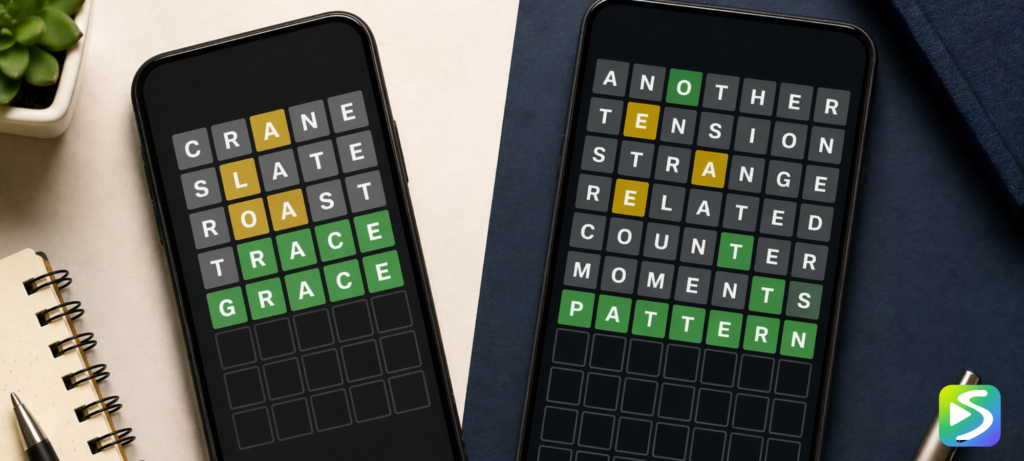
In Wordle, a strong opener covers about half the letter positions right away — hit two or three greens on the first guess and the puzzle often resolves in three to four attempts. In Septle, no single first guess can meaningfully cover seven-letter territory the same way. The best Septle starting words — ANOTHER, TENSION, STRANGE, RELATED — are chosen because they pack a mix of common vowels and consonants across all seven positions, but even a strong first guess only confirms a fraction of the word. See the best starting words for Septle guide for a full breakdown.
Experienced Septle players treat the first two guesses as a unit — planning them together to cover as many distinct letters as possible, rather than reacting guess-by-guess the way Wordle rewards.
Vocabulary Range
Wordle’s word list stays within a relatively approachable range curated by The New York Times. Septle draws from a wider pool — seven-letter words naturally include more vocabulary that appears in everyday speech but less often in casual reading. Neither game rewards obscure crossword-style vocabulary, but Septle sits a few notches higher on the demand scale, which is exactly why players who’ve grown comfortable with Wordle often describe Septle as the challenge they were looking for.
Is Septle a New York Times Game?
A lot of players discover Septle through Wordle and reasonably assume any popular daily word game must sit inside the NYT Games portfolio. It’s an understandable guess — Wordle’s success under the Times banner has made it the default association for daily word games in general.
But Septle is not part of that portfolio. It has no affiliation with The New York Times, no connection to the NYT Games subscription, and no relationship to Wordle beyond sharing the same color-coded feedback mechanic. The games use entirely separate word lists, separate puzzle numbering, and separate infrastructure. Septle is available free at septle.org — not through nytimes.com — and has never required any subscription.
What Is the “NYTimes Mode” Inside Septle?
Within Septle’s daily session, one of the three puzzles is labeled “NYTimes Word.” This is a five-letter puzzle with six attempts — structurally identical to Wordle. The label exists because the five-letter format became widely associated with The New York Times after its acquisition of Wordle, and Septle uses the name to signal that this particular mode follows that familiar structure. The word itself is not the same as the actual NYT Wordle answer — they’re separate puzzles with separate word lists. Playing Septle’s five-letter mode does not reveal the NYT Wordle answer, and vice versa.
The Actual NYT Games Portfolio
For context: The New York Times acquired Wordle from creator Josh Wardle in January 2022 for an undisclosed price in the low seven figures. Since then, NYT Games has hosted Wordle alongside the Mini Crossword, the full daily Crossword, Spelling Bee, Connections, Strands, and others — most behind a paid subscription after a free trial, though Wordle itself remains free. None of these are Septle. If you want the official NYT word game experience, nytimes.com/games is where you go. If you want a free, independent seven-letter daily puzzle that’s harder than Wordle, septle.org is what you’re looking for.
The Daily Habit: How Each Game Fits Your Routine
Wordle takes most players two to five minutes on a typical day. Septle usually runs five to ten. Many players now run both back to back as a daily brain warm-up — Wordle first for a quick stretch, Septle second as the main workout. Both reset at midnight, give you one puzzle, and don’t carry over attempts between days; missing a day breaks your streak in both. That shared structure is part of why the two games complement rather than compete. For a deeper strategy dive once you’ve started, see how to get better at Septle.
Which One Should You Play?
If you’re new to daily word puzzles, start with Wordle — the five-letter format teaches the core logic of color-coded elimination in a forgiving, well-paced environment. Once that feels comfortable, usually within a few weeks, Septle is the natural next step.
If you already solve Wordle in two or three guesses more often than not, you’re ready for Septle. The jump will feel significant at first — your opening strategy needs to change, and your tolerance for mid-puzzle uncertainty needs to stretch — but most players who make the switch describe Septle as the version that actually challenges them.
If you want both: play both. Combined, they take under fifteen minutes and leave you sharper than a scroll through social media for the same amount of time.
Frequently Asked Questions
Is Septle the same as Wordle?
No. Septle and Wordle share the same color-feedback mechanic — green, yellow, gray — but Septle uses seven-letter words and eight attempts while Wordle uses five-letter words and six attempts. Septle is independent and not affiliated with The New York Times.
Is Septle a New York Times game?
No. Septle has no affiliation with The New York Times or NYT Games. It’s free at septle.org and includes a five-letter mode labeled “NYTimes Word,” which refers to the puzzle format, not an actual NYT product or partnership.
Does Septle’s NYTimes mode give you the real NYT Wordle answer? No. Septle’s five-letter NYTimes mode uses its own separate word list. The answers are different from the official NYT Wordle, and playing one does not reveal the other.
Is Septle harder than Wordle?
Yes, most players find Septle noticeably harder. The seven-letter format needs more guesses to narrow down, the vocabulary range is wider, and each guess reveals a smaller proportion of the total word.
Can you play both Septle and Wordle every day?
Yes. Both reset daily at midnight and take only a few minutes each. Many players run both as part of a morning routine, switching between them seamlessly since the color-feedback logic is identical.
What’s a good starting word for Septle compared to Wordle?
Wordle players often open with five-letter words like CRANE, RAISE, or SLATE. For Septle, ANOTHER, TENSION, STRANGE, and RELATED are popular seven-letter choices because they test a wide spread of common letters in one guess.
Do I need a subscription to play Septle?
No. Septle is completely free — no subscription, no account, no payment of any kind, unlike most of the NYT Games library which sits behind a paywall after a free trial.
That’s the full Septle vs Wordle picture — from the seven-letter format and eight-attempt structure to the honest answer on NYT affiliation. Ready to see how you do? Play today’s Septle puzzle or check today’s hints and answer if you’re stuck.