If you’ve spent any time in the daily word-puzzle corner of the internet, you’ve probably run into both names within the same week. Septle vs Spellie is a comparison a lot of players end up searching for almost by accident — one game turns up while they’re hunting for something harder than Wordle, the other while they’re looking for something a child or a beginner could actually finish. That’s not a coincidence. The two games solve genuinely different problems, and understanding what each one is actually built for will save you the trouble of downloading the wrong daily habit.
This isn’t a “which one wins” argument. It’s a breakdown of what Septle and Spellie each ask of a player, who they’re actually designed for, and how to decide which one — or both — belongs in your rotation.
=> New to the seven-letter format? Start with the complete Septle beginner’s guide.
Quick Answer: What’s the Real Difference Between Septle and Spellie?
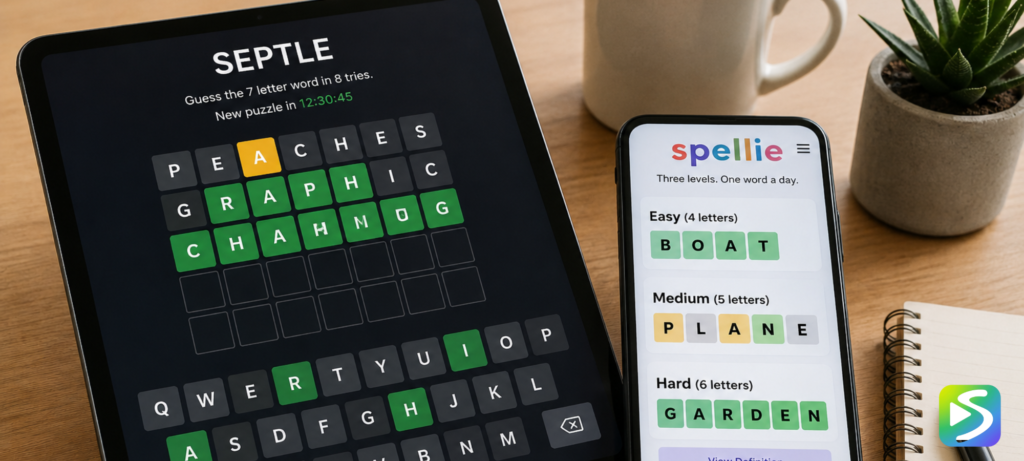
Septle is a free daily seven-letter word puzzle built for adults and experienced word-game players who find Wordle too easy. Spellie, by contrast, is a daily word puzzle explicitly designed for children and beginner readers, built around three separate difficulty tiers tied to school reading levels rather than a single fixed word length. If you want a harder daily challenge, Septle is the better fit. If you’re introducing a young reader — or yourself — to word-guessing games for the first time, Spellie is built specifically for that.
What Is Spellie, Exactly?
Spellie is a browser-based daily word puzzle created by developers Christopher Porter and David Hirtle, first released in 2022. Unlike most Wordle-style games, which lock players into one word length, Spellie runs three separate daily puzzles at three difficulty levels: an Easy puzzle using four-letter words pitched at roughly a second-grade reading level, a Medium puzzle using five-letter words comparable to standard Wordle, and a Hard puzzle using six-letter words drawn from around a fifth-grade vocabulary. Players get six guesses per puzzle and can move between the three levels freely rather than solving them in a fixed order.
The color-feedback system will feel immediately familiar to anyone who has played Wordle or Septle — green for a correct letter in the correct position, yellow for a correct letter in the wrong spot, and no color (or gray, depending on the version) for a letter that isn’t in the word at all. Where Spellie diverges is in tone and intent: it’s explicitly marketed toward young spellers, and several versions of the game reveal a definition of the answer word once you solve it, turning each round into a small vocabulary lesson rather than just a puzzle.
Septle: The Harder, Adult-Focused Alternative
Septle takes the opposite approach. Instead of scaling difficulty down for younger readers, it scales up for players who’ve outgrown five-letter puzzles entirely. Every day, Septle presents one shared seven-letter word to every player worldwide, with eight attempts to solve it — two more than Wordle allows, but not nearly enough to offset how much harder a seven-letter word pool actually is. The vocabulary draws from genuine adult English, including words with less common prefixes and suffixes that rarely show up in shorter formats.
Septle also bundles in a six-letter bonus puzzle and a five-letter “NYTimes-style” puzzle within the same daily session, giving experienced players a full session of graduated difficulty rather than a single round. None of this is designed with children in mind — the word list, the difficulty curve, and the eight-guess structure all assume a player who already understands the color-feedback mechanic and wants a genuine challenge, not an introduction to one.
Septle vs Spellie: Side-by-Side Comparison
| Septle | Spellie | |
|---|---|---|
| Word length | 7 letters (fixed) | 4, 5, or 6 letters (three levels) |
| Attempts | 8 | 6 per level |
| Target audience | Adults, experienced word-game players | Children, beginner readers |
| Difficulty | Genuinely challenging | Easy to moderate, by design |
| Bonus content | Six-letter and five-letter modes included | Three levels playable in any order |
| Post-solve extras | Streak and guess-distribution tracking | Word definition reveal on solve |
| Cost | Free, no account | Free, no account |
Who Should Actually Play Which?
If you’re an adult who’s been solving Wordle in two or three guesses for months and it no longer feels like a real test, Spellie’s easy and medium tiers won’t scratch that itch — they’re calibrated for a much younger reading level. Septle’s seven-letter format, wider vocabulary range, and tighter guess-to-difficulty ratio are the more natural next step. The best starting words for Septle guide is worth reading before your first attempt, since opener strategy matters more at seven letters than it does at five.
If you’re looking for something to play with — or teach — a child, the comparison flips. Spellie’s built-in difficulty tiers and definition reveals make it a genuinely useful vocabulary tool, not just a game dressed up as one. Reading development research consistently points to vocabulary demands rising sharply from around the fourth-grade level onward, which is roughly where Spellie’s difficulty tiers are aimed — making the format’s design choices line up with how reading vocabulary actually develops, according to literacy resources like Reading Rockets.
There’s also a middle case worth mentioning: an adult who wants a genuinely easy, low-stakes word puzzle without the vocabulary demands of Septle or even standard Wordle. Spellie’s easy and medium tiers work fine for that too — nothing about the game restricts it to children, it’s simply built with them as the primary audience.
Can You Play Both?
Yes, and there’s no real friction in doing so. Both games are free, browser-based, and take only a few minutes per session. A reasonable daily rotation might look like Spellie’s easy tier as a quick warm-up, Septle as the main event, and Spellie’s harder tiers or Septle’s own bonus puzzles as a cooldown — though most players will naturally gravitate toward whichever format actually challenges them, since a puzzle that’s too easy stops delivering the daily habit’s usual payoff.
Frequently Asked Questions
Is Spellie the same as Wordle?
No, though it uses the same color-feedback mechanic. Spellie differs by offering three difficulty tiers (four, five, and six letters) instead of one fixed word length, and it’s specifically designed for children and beginner readers rather than a general adult audience.
Is Septle harder than Spellie?
Yes, significantly. Septle’s seven-letter format and adult vocabulary make it considerably more demanding than any of Spellie’s three tiers, which top out at six letters aimed at roughly a fifth-grade reading level.
Which game is better for a child just learning to read?
Spellie is the better fit. Its easy tier uses short, common words at a second-grade level, and the built-in definition reveal after each solve reinforces vocabulary rather than just testing it.
Do Septle and Spellie use the same word list?
No. Each game maintains its own independent word list curated for its specific difficulty target — Septle for challenging adult vocabulary, Spellie for age-appropriate reading levels across its three tiers.
Is Spellie free to play?
Yes. Spellie is free and browser-based with no signup required, the same as Septle.
Can adults play Spellie, or is it only for kids? Adults can absolutely play Spellie — nothing technically restricts it — but experienced word-game players will likely find even its hardest tier fairly easy compared to Septle or standard Wordle.
Final Thought
Septle and Spellie aren’t really competing for the same player. One is built to be the hardest five minutes of your morning; the other is built to make word-guessing approachable for a reader who’s just starting out. Knowing which problem you’re actually trying to solve makes the choice straightforward. Play today’s Septle puzzle if the seven-letter challenge is what you’re after.