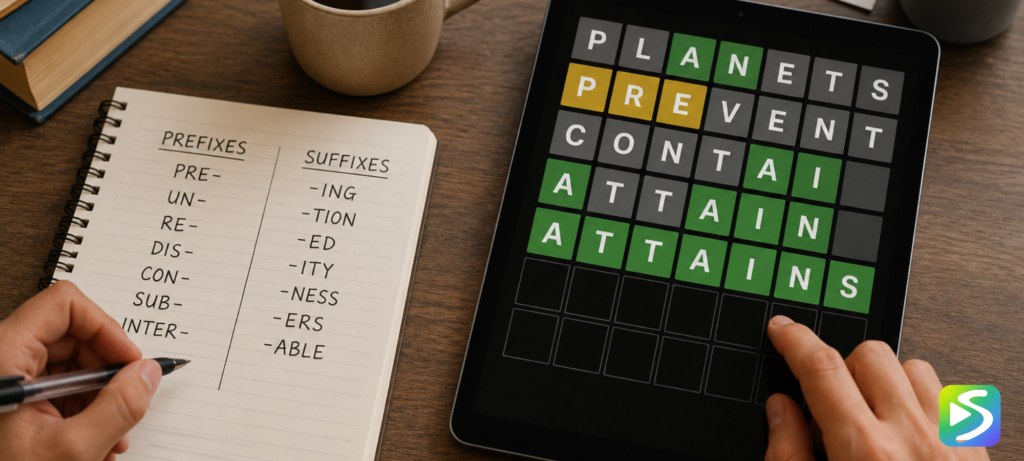
We’ve all been there. You’re deep into your daily Septle session. You’ve burned through five of your six attempts, and the grid is staring back at you—mostly gray, with a few frustratingly placed yellows and a green or two. You know the word is there; it’s dancing just behind your eyes, but you can’t quite grab it. Your heartbeat picks up, the timer feels like it’s accelerating, and that familiar wave of “puzzle-burnout” starts to settle in.
Most casual players treat Septle like a game of pure luck, guessing common vowels and hoping for a miracle. But if you watch a master player, they aren’t guessing—they are analyzing. They’ve stopped looking for letters and started looking for structures.
Becoming a Septle pro isn’t about having a massive, dictionary-sized vocabulary. It’s about Pattern Recognition. By mastering the building blocks of the English language—specifically prefixes and suffixes—you can turn a guessing game into a logical challenge. In this guide, we’re going to tear down the mechanics of 7-letter words and show you how to solve Septle faster, smarter, and with way less stress.
Table of Contents
- The Science of Cognitive Pattern Recognition
- Why Prefixes and Suffixes are Your Best Friends
- The “Common Culprit” Strategy: Suffixes That Win
- Mastering the Start: High-Frequency Prefixes
- Case Study: A Logical Walkthrough
- Comparison: Strategic Guessing vs. Random Luck
- Building Your “Brain Bank”: Tips for Daily Growth
- Frequently Asked Questions (FAQs)
- Conclusion
The Science of Cognitive Pattern Recognition
Why does identifying a “suffix” help you solve a puzzle? It’s all about cognitive load. When you look at seven empty squares, your brain faces an almost infinite number of combinations. This is overwhelming.
However, when you identify that a word ends in “-ING,” your brain immediately collapses those three slots into a single unit. You aren’t solving for 7 letters anymore; you’re solving for 4. This simple shift in perspective reduces the pressure on your working memory, allowing you to focus your mental energy on the remaining “root” of the word. It’s the difference between trying to find a needle in a haystack and already having the magnet in your hand.
Why Prefixes and Suffixes are Your Best Friends
In English, words aren’t just collections of random letters; they are modular. You have a “root,” and you build around it. In 7-letter puzzles, this structure is your roadmap.
If you guess the letters T, I, O, and N, and they all turn green or yellow, stop trying to guess random vowels. Your brain should immediately pivot to the “-TION” suffix. By committing these small modular units to your memory, you stop guessing and start constructing.
The “Common Culprit” Strategy: Suffixes That Win
If you are struggling to finish a word, look at the end of the grid first. English is heavily dependent on specific word endings. If you have any of the following letters in your “found” pile, try placing them at the end of the word before doing anything else:
- -ING: The absolute king of word games. If you see an ‘I’, ‘N’, and ‘G’, 90% of the time, they belong at the end.
- -TION / -SION: These four letters occupy more than half your grid. If you find these, you have essentially already won the game.
- -ED: The standard indicator for past-tense verbs.
- -ITY: Very common in abstract concepts (think: QUALITY, UTILITY, DENSITY).
- -NESS: A great way to turn adjectives into nouns.
Pro-Tip: Don’t just guess the letters—guess the position. If you know a word ends in ‘-ING’, don’t waste an attempt testing a letter in the 7th slot if you already know it’s a ‘G’.
Mastering the Start: High-Frequency Prefixes
Just as the end of the word is predictable, the start is often framed by classic prefixes. If you are starting your game with ‘P’, ‘R’, ‘E’ or ‘D’, ‘I’, ‘S’, don’t waste time—lean into those patterns.
- PRE-: Think PREPARE, PREVENT, PREDICT.
- DIS-: Think DISMISS, DISPLAY, DISPUTE.
- CON-: A massive contributor to the 7-letter pool (CONNECT, CONTENT, CONCERT).
- SUB-: Very reliable for words like SUBJECT, SUBMIT, SUBLIME.
- UN-: Often paired with common roots to create opposites (UNUSUAL, UNKNOWN, UNIFIED).
Case Study: A Logical Walkthrough
Let’s say you’ve played two rounds. Your board looks like this:
_ _ _ _ E R S
The beginner player sees this and thinks, “Okay, I need to find the first four letters.” They might guess L-A-T-E-R-S or F-A-T-E-R-S.
The strategic player looks at the “-ERS” suffix and immediately thinks: “This is likely a plural noun or a third-person verb.” They don’t guess L-A-T-E-R-S. They look for roots that fit before “-ERS”. They try P-R-A-Y-E-R-S, P-L-A-Y-E-R-S, or P-E-A-K-E-R-S. By using the suffix as an anchor, they’ve narrowed their focus to only words that fit the linguistic structure of the grid.
Comparison: Strategic Guessing vs. Random Luck
| Approach | Logic Used | Success Probability | Why? |
| Random Luck | None (Vowel hunting) | Very Low | You are fighting the dictionary, not solving it. |
| Vowel Fishing | Basic Vowel check | Moderate | Helpful, but often wastes 2-3 turns. |
| Pattern Analysis | Linguistic structure | Very High | You are leveraging how the English language is built. |
Building Your “Brain Bank”: Tips for Daily Growth
How do you actually get better at this? You need to expand your internal “Brain Bank.”
- Read with Intent: Don’t just read for the story. When you see a 7-letter word in an article, take one second to acknowledge its structure. Is it a prefix? A root? Does it have a common suffix?
- Practice Daily Brain Exercise Habits: Your brain is a muscle. If you only play once a week, you’ll never build the “neural pathways” necessary to spot patterns instantly.
- Learn from the “Solver”: It’s okay to get stuck. When you do, use a Septle solver to see the answer. But don’t stop there! Analyze why that word was chosen. Was it the root? Was it a suffix you missed? Treating every loss as a lesson is how you guarantee your next win.
Frequently Asked Questions (FAQs)
Q1: Is pattern analysis “cheating”?
Absolutely not. Every great Scrabble, crossword, or word puzzle champion uses pattern recognition. It is simply the application of linguistic knowledge to a logical problem.
Q2: Should I focus on prefixes or suffixes first?
Always start with vowels. Once you have a handle on the vowels, look for the most common suffixes (-ING, -ED, -TION) because they usually account for 3 or 4 of your 7 letters.
Q3: How do I handle words that don’t follow standard patterns?
The “outliers” are why you have six attempts! Use your first three attempts to test common structures. If they fail, that’s when you pivot to testing less common vowels or “weird” consonant pairings.
Q4: Will this help me in other games besides Septle?
Yes. Whether you are playing Wordle, Connections, or even doing a crossword, the ability to decompose a word into its prefix, root, and suffix is a transferable skill that makes you a better communicator overall.
Conclusion
At the end of the day, Septle isn’t just about guessing letters—it’s about understanding the logic of our language. By shifting your approach from random guessing to strategic pattern recognition, you move from being a frustrated player to a logical architect of your own wins.
The next time you open your browser to play your daily puzzle, don’t just look at the empty grid. Look for the suffix, identify the prefix, and watch as those seven letters fall right into place. It’s not magic; it’s just the language doing what it’s meant to do. Now, take a deep breath, trust your logic, and go get that win!
For further reading on the fascinating mechanics of language: