When Wordle became a global phenomenon in early 2022, the design conversation that followed focused mostly on what it did not have. No push notifications. No ads. No monetization pressure. No social features designed to trigger compulsive checking. In a landscape of apps engineered to maximize time-on-screen through anxiety and urgency, Wordle and the games that followed it — including Septle — took a different approach. Understanding how these games are designed explains both why they are so enjoyable and why the daily habit they create feels different from most app habits.
The One-Puzzle-Per-Day Architecture
The most distinctive design decision in daily word games is the artificial scarcity of one puzzle per day. This is a constraint, not a limitation — and it is one of the most psychologically intelligent design choices in modern app design.
Most apps are designed to maximize sessions and time-on-screen. More engagement means more opportunities for monetization, more data, more habit formation. The incentive for an app developer is usually to keep users in the app as long as possible and to bring them back as often as possible.
One-puzzle-per-day reverses this completely. The game actively prevents you from playing more than one puzzle in the daily window. This creates artificial scarcity — and scarcity makes things more valuable. The daily puzzle feels meaningful specifically because you cannot rush through ten more when it is done. You get one shot, and then you wait.
Streaks and the Psychology of Consistency
The streak counter — a number that increments each day you play and resets to zero if you miss — is one of the most effective behavioral design elements in daily puzzle games. On the surface it looks like a simple gamification feature. Beneath that, it is exploiting several well-documented psychological mechanisms simultaneously.
Loss aversion is the cognitive bias that makes losses feel more painful than equivalent gains feel pleasurable. Once a streak reaches two or three weeks, missing a day does not just fail to add to the streak — it destroys the progress you have built. The asymmetry between maintaining the streak and losing it creates powerful motivation to play on days when you might otherwise skip.
There is also the sunk cost effect, which makes the accumulated value of a long streak feel like something worth protecting even beyond the immediate enjoyment of the game. A player with a two-hundred-day streak is not just protecting today’s play — they are protecting the perceived value of two hundred consecutive days of investment.
Septle uses this streak mechanic effectively. The streak counter is visible in the stats panel and is one of the first things players mention when they describe their relationship with the game. If you are currently building a streak, the Septle also includes a streak export feature that lets you carry your streak across devices — a design detail that specifically reduces the barrier to maintaining the habit.
Color Feedback and Variable Reward
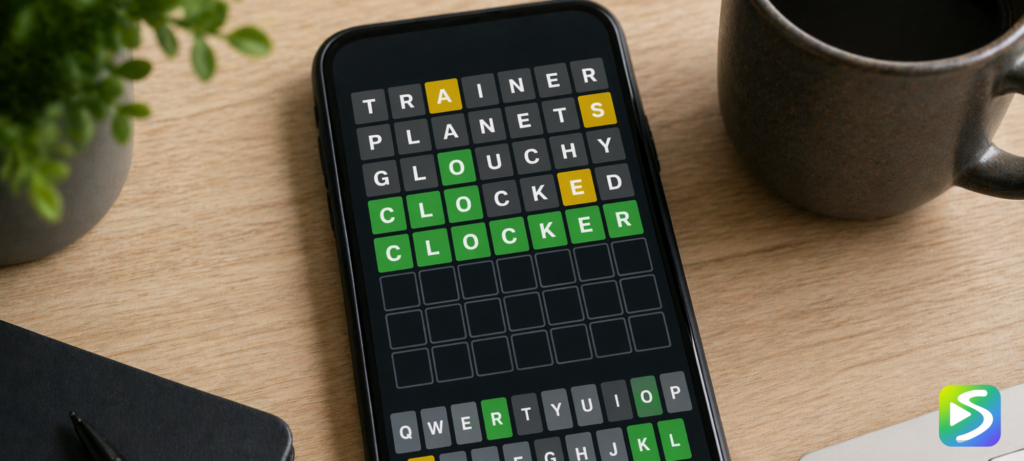
The green-yellow-gray feedback system is elegant because it provides precise, unambiguous information in a visually immediate format. But it also functions as a variable reward mechanism, which is one of the most powerful tools in behavioral design.
Variable reward means that the quality of the outcome varies in a way you cannot fully predict. Some days you get three greens on your first guess and the puzzle resolves satisfyingly fast. Other days your first guess returns seven gray tiles and you stare at an almost completely empty board. Both outcomes keep you engaged in different ways — the fast resolution feels like a skill demonstration, and the hard session feels like a problem to be solved.
The best word game days are not the easiest ones. Players consistently report that their most memorable sessions involve puzzles that initially seemed unsolvable and then clicked into place after careful reasoning. Difficulty, within a range that is usually conquerable, increases the reward of solving rather than decreasing it.
Social Sharing Without Social Pressure
The grid-sharing format — where players share their result as a pattern of colored squares without revealing the word — is a design solution to a genuine tension in social game design. Social features drive engagement, but they also create comparison pressure that can make games feel stressful rather than enjoyable.
The colored square format solves this by making the shared result informative but not fully legible to non-players. The grid tells other players how many guesses you took and roughly how your path went, without exposing the specific words you tried. This creates a social layer that encourages sharing without requiring it, and that communicates achievement without creating embarrassment about a bad result.
For players who want to understand the strategic dimension behind what their shared grids reflect, the guide on how to get better at Septle covers the decision logic behind each guess type — which is also the logic reflected in the patterns of the shared grid.
Why These Games Do Not Use Notifications
Most apps rely on push notifications as a primary re-engagement tool. They are cheap to implement, proven to drive opens, and can be calibrated to create the anxiety of potentially missing something. The design trade-off is that notification-driven engagement creates a relationship between the app and the user built on interruption and mild anxiety rather than genuine desire.
Daily word games have largely avoided this. Septle does not send push notifications. The engagement mechanism is entirely internal — the habit, the streak, and the daily ritual — rather than externally triggered. This design choice produces a different kind of user relationship: players come to the game because they want to, not because they were summoned.
This is partly why daily word game habits feel sustainable in a way that notification-driven app habits rarely do. Research on technology habits and wellbeing from Harvard Health Publishing suggests that autonomy in engagement — choosing to do something rather than being pulled to it — is associated with higher satisfaction and lower anxiety. Word games sit in the autonomous engagement category almost entirely.
The Design of the Puzzle Itself
The word list in a daily puzzle game is a design artifact as much as the interface. Too many obscure words and the game feels arbitrary and punishing — players lose not because of poor reasoning but because the answer was a word they could not have known. Too many obvious words and the game feels trivially easy. The right calibration keeps the puzzle in the zone of genuine challenge that is usually conquerable with good thinking.
Seven-letter word games like Septle face a harder calibration challenge than five-letter games because the vocabulary range is wider and the distribution of word familiarity is more varied. The best daily word game answers are words that feel obvious in retrospect — the kind of answer that makes you say “of course” rather than “how was I supposed to know that.” Getting to that feeling on a seven-letter puzzle requires careful word list curation.
Frequently Asked Questions
Why are daily word games more addictive than other mobile games?
Daily word games use several powerful behavioral design mechanisms — artificial scarcity, streak maintenance, variable reward, and social sharing — without the dark patterns common in other mobile games like pay-to-win mechanics or manipulative notifications. The result is an engagement habit that feels genuinely positive rather than compulsive.
Why do word games only give you one puzzle per day?
The one-puzzle-per-day constraint is a deliberate design choice that creates artificial scarcity, making the daily puzzle feel more valuable than it would if unlimited play were available. It also creates the shared daily experience that makes word games social — everyone plays the same puzzle on the same day.
How do word game streaks work psychologically?
Streaks exploit loss aversion — the cognitive bias that makes losing accumulated progress feel worse than an equivalent gain feels good. Once a streak reaches a few weeks, the prospect of losing it becomes more motivating than the enjoyment of the game itself. This creates powerful daily engagement even on low-motivation days.
Why do word games not send push notifications?
Most successful daily word games rely on internal motivation mechanics — habit, streak, and daily ritual — rather than external triggers like notifications. This produces a different user relationship: engagement is autonomous rather than prompted, which is associated with higher satisfaction and lower app-related anxiety.
Are word game apps good for you compared to other apps?
Daily word games compare favorably to most other app categories from a wellbeing perspective. They are time-bounded, cognitively engaging, non-anxious in their engagement mechanics, and social without creating comparison pressure. The cognitive benefits of regular word puzzle engagement are also better supported by research than the benefits of most other mobile app categories.