
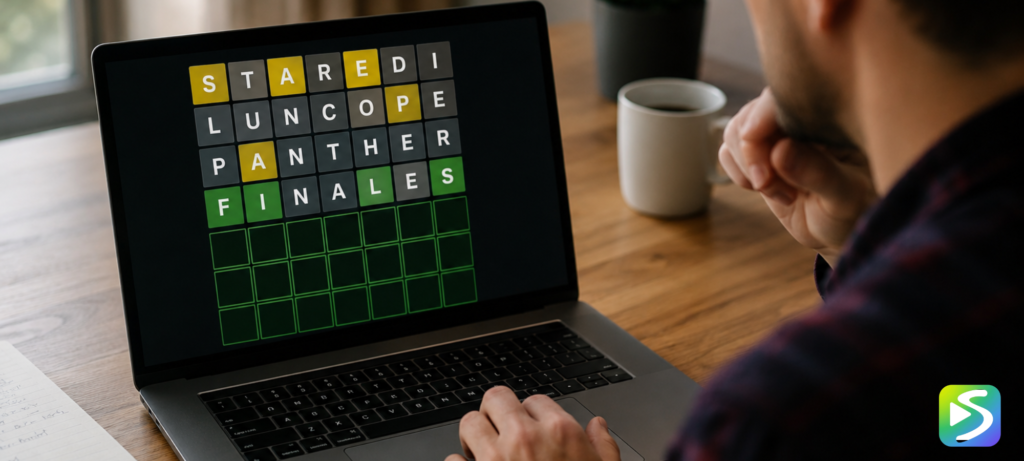
If you have ever felt like your Septle games are decided within the first thirty seconds, you aren’t just imagining it. There is a cold, hard mathematical reality behind word puzzles. In a game of seven letters, the search space is vast, but it is not infinite. Your first two moves are the most critical decisions you make—they act as the “search filters” that eliminate thousands of incorrect possibilities while highlighting the right path.
Most players treat their opening words as a creative exercise. They pick their favorite word, or maybe a word that feels “lucky.” But if you want to climb the leaderboard and consistently solve your daily puzzle, you need to stop playing with your heart and start playing with your head. This is the Mathematics of Winning.
Table of Contents
- The “Search Filter” Concept: Why First Moves Matter
- The Vowel-to-Consonant Ratio: Finding the Sweet Spot
- The Frequency Matrix: Why Some Letters Are More Valuable
- Case Study: The “Efficiency Trap”
- Strategies for the Perfect First Two Moves
- Comparison: Strategic Openers vs. Random Guesses
- Frequently Asked Questions (FAQs)
- Conclusion
The “Search Filter” Concept: Why First Moves Matter
Think of your first move as a wide-angle lens. You aren’t trying to find the word immediately; you are trying to find the structure of the word. A successful first move in Septle is one that provides maximum data about the word’s internal skeleton.
Mathematically, if you use a word like “QUEUEING,” you are wasting multiple slots on repeated letters. You are essentially throwing away data points. The goal of a “high-entropy” starting word is to maximize the number of distinct, high-frequency letters tested. Every letter that turns gray is just as valuable as one that turns green—because it clears the path ahead.
The Vowel-to-Consonant Ratio: Finding the Sweet Spot
In 7-letter words, the distribution of vowels is generally consistent. Most English words contain at least two, but rarely more than four, vowels.
A mathematically sound opener usually targets a 3:4 or 4:3 ratio of vowels to consonants. If you open with a word consisting entirely of consonants, you will likely spend your second and third moves “fishing” for vowels. Conversely, opening with four or five vowels limits your ability to test the consonants that define the word’s structure (like S, T, R, or L).
The Frequency Matrix: Why Some Letters Are More Valuable
In English linguistics, not all letters are created equal. The letters E, A, R, I, O, T, N, and S appear with significantly higher frequency than J, X, Q, or Z.
When choosing your opener, you should be looking to maximize your “Coverage Score.” If you use a word like “TRAINED,” you are hitting the six most common letters in the English language simultaneously. This is not just a guess; it is a calculated statistical probe. You are effectively scanning the most likely “neighborhood” of the dictionary for your target word.
Case Study: The “Efficiency Trap”
Consider two players.
- Player A opens with “PIZZAZZ.” It feels fun, and it uses unique letters, but it ignores the high-frequency consonant cluster analysis.
- Player B opens with “STAREDI” (a hypothetical construct for testing).
By turn two, Player B has already identified the presence of ‘S’, ‘T’, ‘R’, ‘E’, and ‘D’. They have eliminated the most common “red herrings” in the language. Player A, on the other hand, is still guessing letters that have a 0.01% chance of appearing. Player B isn’t “luckier”—Player B has simply reduced the remaining search space by 80% before their second move is even complete.
Strategies for the Perfect First Two Moves
How do you build this into your routine? Follow this two-step architecture:
- Move 1 (Broad Scan): Use a word that maximizes distinct, high-frequency letters. Avoid double letters unless you are confirming a known pattern. Your goal is to see which of the “Big Eight” (E, A, R, I, O, T, N, S) are present.
- Move 2 (Targeted Refinement): Based on the results of move one, pivot. If you hit ‘S’ and ‘T’ but no vowels, your second word should be a “Vowel-Heavy Probe” (e.g., words containing A, I, and O).
By the end of your second turn, you should have identified at least two vowels and two of the major consonant anchors. If you haven’t, you need to adjust your daily brain exercise habit to include more linguistic pattern analysis.
Comparison: Strategic Openers vs. Random Guesses
| Metric | Strategic Opening | Random/Lucky Opening |
| Data Yield | High (4+ letters confirmed) | Low (0-1 letters confirmed) |
| Win Probability | Consistent (Above 85%) | Volatile (Below 50%) |
| Decision Load | Low (Logic-driven) | High (Guesswork) |
| Frustration | Minimal | High |
Frequently Asked Questions (FAQs)
Q1: Does the same starting word work every day?
While having a “go-to” word is helpful, the most successful players vary their opening based on the previous day’s results or by simply rotating between 3-4 high-frequency openers to ensure full coverage over time.
Q2: Is it better to focus on vowels or consonants first?
Always start with a balance. Consonants provide the “skeleton” of the word (the pattern), while vowels provide the “connective tissue.” You need both to solve effectively.
Q3: Should I use a Septle solver to find openers?
Using a solver to analyze why a word is a good opener is a brilliant way to learn. It helps you understand the frequency distribution of the words in the Septle dictionary.
Q4: Does the mathematics change for 7-letter words versus 5-letter ones?
Yes. In 7-letter games, you have more “room” to accommodate prefixes and suffixes, which means consonant clusters are even more important than they are in 5-letter games.
Conclusion
Winning at Septle is not a game of chance; it is a game of information management. When you treat your first two moves as a mathematical experiment rather than a creative whim, you stop guessing and start solving. By focusing on high-frequency letters, maintaining a balanced vowel-to-consonant ratio, and using your early turns to filter out the noise, you can drastically improve your consistency.
The math doesn’t lie: those who analyze the patterns and respect the probabilities are the ones who walk away with the win. So, for your next game, don’t just pick a word you like—pick a word that works. Your logic will be rewarded by the screen turning green.
For further reading on the science of probability and linguistics:
- The Harvard Gazette on the statistics of language and word puzzles.
- The Linguistic Society of America’s principles of English vocabulary structure.
Focus Keyword: The Mathematics of Winning